
Ontario Motorcycle & Scooter Licensing Guide: M1, M2, Class M & LSM Explained

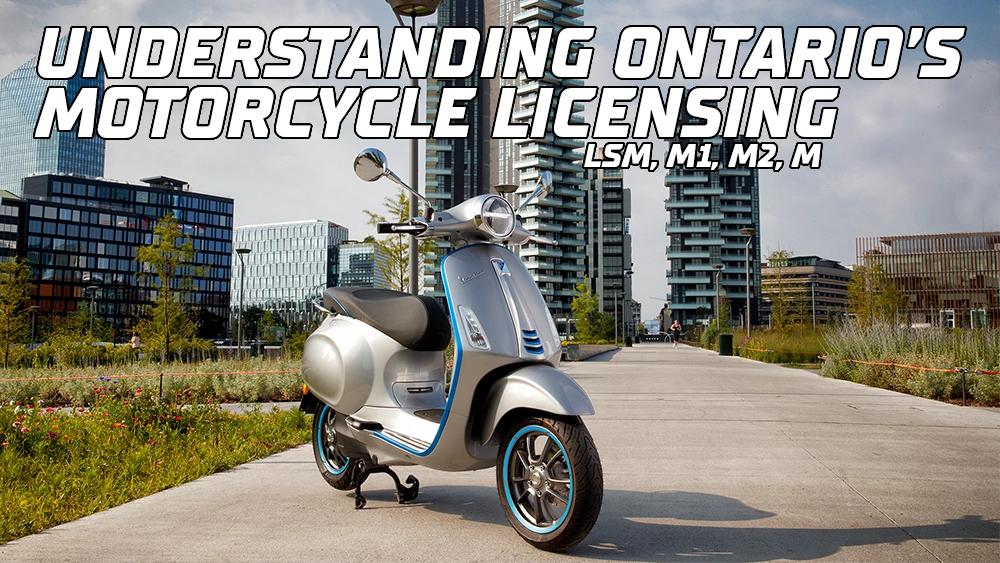
Ready to Ride? Know Your Ontario Licence.
Thinking about a Vespa, Piaggio, scooter or motorcycle? Before you hit the road, make sure you understand Ontario's licensing, registration, insurance and vehicle rules.
Getting around Ontario on two wheels can be an incredibly fun, practical and economical way to travel. But before you choose your ride, it helps to understand how Ontario classifies motorcycles, scooters, mopeds and electric vehicles.
Understanding Ontario's Motorcycle Licence System
Ontario uses a graduated motorcycle licensing system. Depending on the vehicle you ride, your licence may also carry a condition restricting you to certain types of motorcycles, mopeds or limited-speed motorcycles.
M1
Your beginner motorcycle licence. You must be at least 16, pass the required vision test and motorcycle knowledge test, and follow M1 restrictions while learning.
M2
After successfully completing your first road test, you move to M2 and gain additional riding privileges while continuing to follow the conditions of your licence.
Class M
Successfully completing the final Class M road test gives you your full motorcycle licence, subject to any applicable vehicle-specific conditions.
Important: Ontario licensing is not simply a matter of "50cc versus 51cc." The legal classification of the vehicle matters, particularly when dealing with limited-speed motorcycles, mopeds and electric vehicles.
From M1 to M2 to Your Full M
Ontario's graduated licensing system is designed to give new riders time to develop their skills before earning a full motorcycle licence.
You must be at least 16 years old and pass the required vision and motorcycle knowledge tests. Your M1 is valid for 90 days.
You must hold your M1 for at least 60 days before taking the first motorcycle road test.
Successfully completing the first road test moves you from M1 to M2.
Normally, you can take your final Class M road test after 22 months at M2. Completing an approved motorcycle safety course can reduce this period to 18 months.
Successfully completing the final Class M road test earns your full motorcycle licence.
Riding a scooter? Make sure you understand whether your licence has an L condition. An L condition can restrict the rider to qualifying limited-speed motorcycles and mopeds.
What Are the M1 Restrictions?
M1 is a learner licence, so there are important restrictions designed to reduce risk while new riders gain experience.
- Maintain a zero blood-alcohol level.
- Ride only during permitted daylight hours.
- Do not carry passengers.
- Wear an approved motorcycle helmet unless a legal exemption applies.
- Generally avoid roads with speed limits above 80 km/h, subject to Ontario's specified exceptions.
- Follow all other conditions that apply to your M1 licence.
What Changes With an M2?
Passing your first road test is a big milestone. With an M2, riders gain additional privileges, including the ability to ride at night and on roads that were restricted under M1.
M2 riders must continue to maintain a zero blood-alcohol level and follow the conditions attached to their licence.
Safety Courses: Completing an approved motorcycle safety course is a great way to build real-world riding skills, learn valuable safety techniques, potentially reduce insurance costs, and shorten the waiting period before completing your full Class M licence.
What Is a Limited-Speed Motorcycle?
A Limited-Speed Motorcycle (LSM) is a specific legal vehicle classification in Ontario. LSMs are commonly associated with smaller scooters and mopeds, but the classification is based on specific regulatory requirements rather than simply the engine size or advertised top speed of a vehicle.
Under Ontario's current definition, a qualifying LSM can have a maximum attainable speed of 70 km/h or less and, depending on how the vehicle qualifies, must meet additional requirements relating to its design and construction. These include factors such as a minimum 650 mm unladen seat height, minimum 250 mm wheel rim diameter, minimum 1,016 mm wheelbase, and, for vehicles qualifying under the engine-displacement criteria, an engine of 50 cc or less.
Ontario also recognizes certain motorcycles manufactured after 1988 as LSMs when the manufacturer has affixed the appropriate LSM/MVL compliance label and the vehicle continues to meet the requirements that applied when it was manufactured.
Look for the label: On many LSMs manufactured after 1988, the vehicle's compliance label can be found on the steering column or underneath the seat. The label should identify the vehicle as an LSM/MVL. This is one of the easiest ways to confirm how a specific scooter is classified.
If a vehicle qualifies as an LSM, the appropriate motorcycle licence is a Class M with an L condition. This licence category also covers qualifying mopeds and restricts the rider to limited-speed motorcycles and mopeds rather than full-speed motorcycles.
Important: Do not classify a scooter solely by its engine displacement, electric motor wattage, or claimed top speed. Ontario's legal classification depends on the vehicle's actual construction, certification and applicable regulatory requirements.
Licence, Registration, Plates & Insurance
Having the right licence is only one part of being road-ready. Road-going motorcycles and mopeds must also meet Ontario's registration, plate and insurance requirements.
- Appropriate motorcycle-class driver's licence
- Valid vehicle registration
- Correct licence plate
- Valid mandatory insurance coverage
- Approved motorcycle helmet and required equipment
- A vehicle that meets applicable Ontario requirements
Ontario also issues a distinctive green licence plate for limited-speed motorcycles.
E-Bike, E-Scooter or Electric Motorcycle?
Electric vehicles can make Ontario's rules confusing because an e-bike, electric kick-style scooter and road-going electric motorcycle are different categories.
Compliant E-Bikes
Ontario e-bikes must meet specific requirements. Among other things, the motor cannot exceed 500 watts and the maximum assisted speed is 32 km/h.
They must also have pedals and meet additional construction and equipment requirements.
Electric Kick-Style Scooters
Ontario has a separate electric kick-style scooter pilot program. Municipalities decide whether to participate and where these vehicles may be operated.
The current provincial pilot runs through November 27, 2029.
Electric Motorcycles & Scooters
A road-going electric motorcycle or scooter is not automatically an e-bike simply because it has an electric motor.
Its Canadian certification and legal vehicle classification determine the applicable licensing, registration and insurance requirements.
Why Classification Matters
A vehicle can look like a bicycle, scooter or motorcycle while being classified differently under Canadian and Ontario rules.
Always verify the actual certification of the vehicle before purchasing it for road use.
Can a Scooter Go on the Highway?
The answer depends on the vehicle and the road.
Being technically capable of travelling at higher speeds does not automatically make every scooter a good choice for every highway. Traffic, wind, acceleration, road conditions and the vehicle's performance all matter.
Limited-speed motorcycles and mopeds are not permitted on Ontario freeways.
Our advice: Choose your scooter based on how you actually plan to use it. A downtown commuter, suburban rider and regular highway traveller may all benefit from different types of scooters.
Choosing the Right Scooter for Your Riding
Once the licensing side is understood, the fun part begins. Engine size is not a shortcut for determining your licence, but it can make a major difference in how a scooter feels and where it works best.
Small Scooters
Lightweight and easy to handle, smaller scooters are well suited to short urban trips, neighbourhood transportation and riders who value easy parking and manoeuvrability.
150cc-Class Scooters
A popular choice for commuters looking for a balance of manageable size, useful acceleration and everyday practicality.
300cc-Class Scooters
More performance makes this category attractive to suburban commuters and riders who want stronger acceleration and greater flexibility for longer rides.
Larger Scooters & Motorcycles
Riders who regularly travel longer distances, carry passengers or spend more time on higher-speed roads may benefit from stepping into a larger scooter or motorcycle.
Ride Smart. Ride Prepared.
A scooter may be approachable and easy to ride, but it is still a motor vehicle sharing the road with traffic. Good training and proper equipment are part of every great riding experience.
- Complete an approved motorcycle safety course.
- Wear an approved motorcycle helmet.
- Wear appropriate riding gear for the conditions.
- Keep your scooter or motorcycle properly maintained.
- Know the restrictions attached to your licence.
- Choose a vehicle suited to the roads you actually ride.
Ontario Scooter & Motorcycle FAQ
Do I need a motorcycle licence to ride a scooter in Ontario?
Generally, yes for a road-going motorized scooter that falls under Ontario's motorcycle licensing system. The applicable licence condition depends on the vehicle's legal classification.
Is every 50cc scooter automatically an LSM?
No. Limited-speed motorcycle status is a specific legal classification with defined requirements. Engine displacement alone should not be used to determine the classification.
Does a 500-watt electric motor automatically make something an e-bike?
No. Ontario e-bike rules include multiple requirements, including pedals, maximum assisted speed, motor output and other construction and equipment requirements.
Do scooters need insurance in Ontario?
Road-going motorcycles and mopeds require valid insurance. A compliant e-bike is treated differently and does not require motorcycle insurance.
Can I ride an electric kick scooter anywhere in Ontario?
No. Electric kick-style scooters are governed by Ontario's pilot program and municipal rules. Always check the bylaws where you intend to ride.
How old do I have to be to get an Ontario motorcycle licence?
You must be at least 16 years old to apply for an Ontario motorcycle licence.
Can a motorcycle safety course help me get my full M sooner?
Yes. Completing an approved motorcycle safety course can reduce the normal M2 waiting period before the final road test from 22 months to 18 months.
Should I choose my scooter based only on engine size?
No. Think about where you ride, typical traffic speeds, commuting distance, passenger use, storage needs and the vehicle's actual capabilities.
Ready to Find Your Scooter?
Tell the team at Grand River Power Sports where you plan to ride, what kind of riding you have in mind and what you're looking for. We'll help you find the scooter or motorcycle that makes sense for your lifestyle.
View our 2-Wheel Inventory Contact Grand River Power Sports